
Sampling is a process of analyzing the time domain signal in discrete form which equally spaced.
Basics in Signal Processing
Basics in Signal Processing
What is samping of the signal?
What is sampling rate, fs?
Sampling rate, fs represents the amount of sample read per second
Ts = sampling interval
Note: Also known as sampling frequency.
What is sample size?
The total number of samples captured the perform the Fourier transform
T = total time
What is the frequency resolution?
The equationFrequency resolution is the size between each lines in a spectrum
• two spectral components cannot be distinguished if they are spaced by less than df (they fall into the same spectral bin),
• inaccuracy (error) of determining the frequency of a spectral component is max. ±df/2.
• Larger number of samples (N) increases the resolution.
What is spectral degree of freedom?
The value of degree of freedom in random vibration represents the numbers of averaging for each loop. Given by the equation;

\\
W = Weighting
)
According to MIL-STD 810, the Environmental Engineering Guidelines of the Department of Defense, 120 degree of freedom is recommended for random vibration testing.
According to MIL-STD 810, the Environmental Engineering Guidelines of the Department of Defense, 120 degree of freedom is recommended for random vibration testing.
Averaging method
Some example of averaging method such as;
- RMS averaging
- Vector averaging
- Peak hold averaging
Root Means Square
Root means square (RMS)
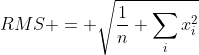
- The square root of the arithmetic mean of the squares of a set of values
- It’s a statistical measure used to determine the magnitude of a varying quantity
- It is common use to define the magnitude of random vibration
Nyquist Theorem
Nyquist Theorem
https://doi.org/10.1016/B978-0-12-819246-7.00013-9
The Nyquist theorem states that an analog signal can be digitized without aliasing error if and only if the sampling rate is greater than or equal to twice the highest frequency component in a given signal.
Ref:Most digital analyzers sample at 2.56 times the maximum frequency of the interest
https://doi.org/10.1016/B978-0-12-819246-7.00013-9